
An Automated MATLAB®–COMSOL Pipeline for Cerebrovascular Fluid–Structure Interaction
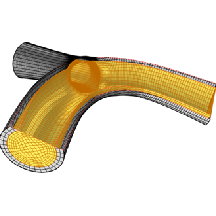
Haemodynamic indicators associated with cerebral atherosclerosis can be quantified using fully coupled fluid–structure interaction (FSI) simulations. However, performing patient-specific FSI analyses across the cerebral vasculature remains computationally intensive. Although neural surrogate models offer a promising alternative by enabling rapid prediction of haemodynamic quantities at a fraction of the computational cost, their development depends on the availability of large, high-quality datasets of FSI simulations. However, the conventional modelling pipeline requires substantial manual intervention in the creation of an FSI-ready mesh for variable vasculature geometry. Consequently, the generation of training datasets for data-driven modelling remains time-consuming. We present a fully automated workflow that transforms cerebral arterial bifurcation centreline data directly into simulation-ready, structured meshes. Unlike traditional cerebrovascular modelling pipelines, which require sequential geometry reconstruction, CAD repair, wall generation, and mesh creation through multiple software packages, the proposed framework generates FSI-ready computational models directly from vascular centreline data, as shown in Figure 1. Cerebral arterial bifurcations are extracted from the BraVa centreline database [1], and structured O-grid hexahedral meshes are generated directly from the centreline representation using the open-source VascularMD framework [2]. A key contribution of this work is the development of an automated tagging strategy that simultaneously defines the fluid domain, vessel wall domain, and all boundary regions. The resulting NASTRAN mesh can be imported directly into COMSOL Multiphysics, where domain and boundary assignments are recognised automatically. Figure 2 shows a sample automatically generated mesh without manual CAD editing, boundary selection, or mesh preparation. In this pipeline, LiveLink™ for MATLAB® automatically imports the tagged NASTRAN mesh into COMSOL and constructs the FSI model. The two-way coupling through the Fluid–Structure Interaction multiphysics interface accommodates fluid-domain deformation. Blood flow is modelled with the Laminar Flow interface as an incompressible non-Newtonian fluid using the Carreau–Yasuda constitutive model. The arterial wall is represented as a neo-Hookean hyperelastic material within the Structural Mechanics interface. Physiological inlet velocity waveforms and diastolic outlet pressure boundary conditions are prescribed to reproduce realistic haemodynamic conditions. A further expected contribution of the work is a parameterised wall-generation framework that decouples wall-thickness specification from mesh generation, treating wall thickness as a design hyperparameter within the meshing workflow. Alternative wall configurations can therefore be produced rapidly while preserving mesh topology and quality, without the geometry regeneration and full remeshing that conventional approaches require. This is expected to enable efficient sensitivity analyses, uncertainty quantification, and large-scale parametric studies without repeated manual remeshing. The proposed workflow produces tagged, structured hexahedral meshes that can be solved as fully coupled two-way FSI models with no manual intervention, as illustrated in Figure 3. In summary, a scalable automated framework for generating high-fidelity cerebrovascular FSI datasets was established, providing a foundation for data-driven surrogate modelling applications.
下载
- 19671_final_poster.pdf - 0.78MB
- 19671_final_paper.pdf - 1.12MB


