Determining an acoustic source distribution of a test rocket from sound pressure level measurements
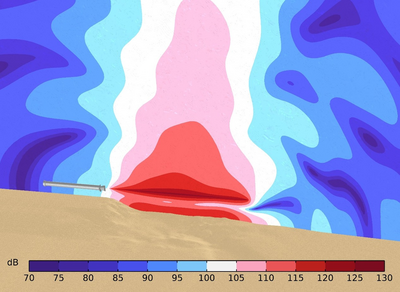
Rocket exhaust during liftoff and landing generates intense acoustic pressure loads that can threaten structural integrity, onboard components, and crew health. Accurate prediction of these loads is therefore critical for robust vehicle and infrastructure design. A major source of uncertainty in current acoustic models is limited knowledge of the spatial distribution of acoustic sources within the exhaust plume. Accurate prediction of the pressure loads provides key information that can be incorporated into component design to avoid these issues. To address the current knowledge gap and better quantify the acoustic source distribution, an inverse methodology was developed in COMSOL Multiphysics to optimize parameters of an assumed functional form of the source distribution using experimental sound pressure level (SPL) measurements at several locations surrounding a test rocket. Both FEM and hybrid FEM-BEM models of the acoustic field surrounding the test device were used to solve the forward problem with different assumed source distributions, including a modified Rayleigh line source and array of point sources. The Optimization Module was used to find the optimal parameters of the assumed source distribution that minimized the total RMS error of the SPL over all measurement positions. For the source distributions considered, the modified Rayleigh line source provided the best fit to experimental data, giving an overall RMS error of 3-6 dB over 19 measurement points. This inverse methodology provides a general method to investigate other potential source term distributions and ultimately provide accurate assessment of pressure loads on critical components.