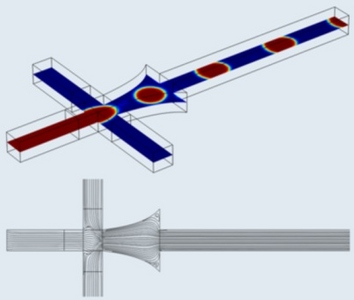
Droplet Generation Modeling in Microfluidic Emulsifying Devices with Expansion Regions
The generation of monodisperse droplets using microfluidic emulsification devices has emerged as a powerful platform supporting broad applications in biomedical engineering, drug delivery encapsulation, materials synthesis, and chemical processing. However, optimizing the performance of these systems remains challenging due to the presence of multiple flow regimes and the strong sensitivity of both the droplet size as well as size uniformity to operating parameters such as flow rates, phase viscosities, and emulsifying region geometry. To address these challenges, we are developing computational models that allow the mapping of the emulsifying regimes as a function of the controlling parameters, and enable more efficient prototyping of emulsifying devices. In particular, we are exploring the effect on the droplet formation and uniformity, when expansion sections are used to control the shear rates in the emulsifying region where droplet formation and breakup occurs.
The models use the CFD Module from COMSOL Multiphysics to solve the Navier-Stokes equations in laminar flow systems, together with interface tracking models (level-set and phase-filed) to visualize the evolution of the boundaries between the immiscible fluids, that define the droplets.