
Simulation Analysis Of Combined Electric And Acoustic Sources To Predict Fish Deterrence Drivers
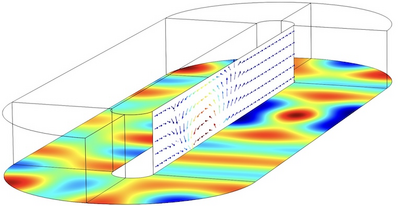
Electrical dispersal deterrents are the most mature technology for deterring invasive species in open waterways. However, they pose human safety risks, incur high operational costs, and exhibit reduced efficacy against smaller fish. Consequently, current research focuses on optimally combining multiple types of deterrents to maximize fish avoidance. This work investigates the incorporation of electric and acoustic sources within a single domain using COMSOL Multiphysics® simulations and laboratory experiments. The simulations utilize the Electric Currents and Pressure Acoustics interfaces to predict the primary drivers that deter the fish (voltage gradient and acoustic pressure) in a 3D domain representing the physical fish flume at the Environmental Laboratory. Laboratory experiments with in-water mapping methods are conducted to validate and calibrate the models. These models predict the spatial distribution of deterrence drivers, providing a capability that extrapolates to full-scale installations, reducing the need for resource-intensive in situ mapping. Furthermore, accurately predicted distributions will establish a critical link between deterrence drivers and fish behavior, facilitating optimal placement and parameterization of multiple types of non-structural deterrents to maximize fish avoidance.
下载
- COMSOL2026_Final.pdf - 1.09MB
- COMSOL-Conference-2026-Boston-Frisch-Final.pptx - 3.6MB


