
A Multiphysics Framework for Quantitative Assessment of Operational Resource Depletion
The long-term persistence of technological civilizations remains one of the fundamental questions of thermodynamics, sustainability science and resource economics. Previous discussions have traditionally focused on the finiteness of available resources as the primary limitation to sustained growth. However, we argue that the decisive physical constraint is not the total quantity of matter or energy available, but the finite rate at which those resources can be accessed, transported, transformed and incorporated into an organized system.
Building upon this hypothesis, we preserve the conceptual framework previously proposed, where three fundamental evolutionary regimes can be identified. The first corresponds to dissipative cycles of growth and collapse, in which each expansion irreversibly consumes part of the accessible energetic base, progressively reducing the capacity for subsequent recovery. The second describes quasi-stationary civilizations operating close to thermodynamic reversibility. In this regime, long-term persistence becomes possible through extensive reuse, low dissipation, limited transformation rates and dynamic equilibrium instead of permanent expansion. The third regime considers civilizations expanding within open systems. Although external resources may be effectively unlimited, growth remains constrained by finite rates of access imposed by transport processes, communication delays, extraction capacities and thermodynamic dissipation. Consequently, operational accessibility rather than total resource abundance becomes the governing variable.
The principal contribution of the present work consists of transforming these conceptual scenarios into a quantitative multi-physics framework. Resource accessibility is represented by a normalized scalar field governed by an effective transport equation with localized consumption. Finite accessibility to an external reservoir is introduced through a Robin boundary condition, representing the effective conductance governing resource incorporation. Unlike conventional depletion models, operational failure is not defined by exhaustion of the external reservoir, but by the inability of the accessible resource flow to satisfy local demand. The critical condition is therefore expressed as a bound of the resource availability at the principal consumption region.
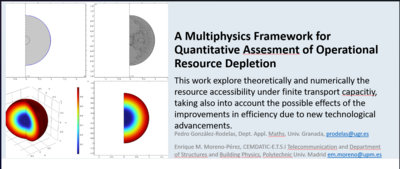
The physical model is implemented in COMSOL Multiphysics using a two-dimensional axisymmetric domain, allowing efficient representation of three-dimensional transport while preserving moderate computational cost. The numerical simulations provide the temporal evolution of concentration fields, transport fluxes, accessibility gradients and remaining resource inventories for different transport and consumption scenarios. To move beyond deterministic analyses, uncertainty is incorporated by considering stochastic variations in transport capacity, accessibility, external availability and demand evolution. Instead of estimating a unique depletion time, the methodology seeks the probability distribution of operational depletion.
The reduced dynamics are represented as a stochastic differential equation, whose associated probability density satisfies the Fokker{Planck equation, whose formulation allows direct estimation of the probability that operational depletion occurs before a prescribed time horizon. Consequently, the proposed framework naturally provides probabilistic depletion windows, confidence intervals and quantitative risk metrics rather than deterministic predictions.
The computational workflow combines COMSOL Multiphysics as the high-fidelity physical solver with MATLAB Live Scripts for automatic parameter estimation, model calibration, uncertainty propagation, numerical solution of the reduced stochastic model, sensitivity analysis and post-processing. This hybrid architecture enables reproducible computational experiments while maintaining the physical consistency of the underlying transport model. The proposed methodology preserves the conceptual interpretation of persistence and expansion while extending it into a quantitative predictive framework. Rather than replacing the original thermodynamic argument, the numerical model provides a mathematical representation capable of identifying the transition between collapse, quasi-stationary persistence and expansion under finite access constraints. Owing to its abstract formulation, the framework is independent of any particular resource and may be applied to energy systems, freshwater, minerals, biomass, hydrogen, food resources or any conserved quantity whose availability is governed by transport-limited accessibility.
The long-term objective of this research is therefore not the prediction of a unique depletion date, but the quantitative evaluation of operational resource accessibility and the probabilistic assessment of depletion risk under realistic physical constraints.
下载
- 19461_final_poster.pdf - 0.91MB
- 19461_final_paper.pdf - 0.94MB


