
Geomechanical Workflow in COMSOL Multiphysics to Evaluate Hydrothermal Unrest at Campi Flegrei
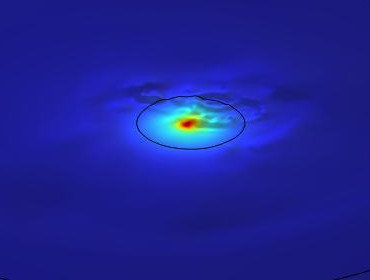
The ongoing unrest at the Campi Flegrei caldera (Italy), characterized by intense ground uplift (bradyseism) and seismicity, is largely driven by the dynamics of deep hydrothermal fluids. Accurately modeling surface deformations requires coupling complex fluid-dynamic scenarios with the realistic mechanical response of the volcanic structure. In this work, we present an advanced 3D finite element model developed in COMSOL Multiphysics to evaluate the geomechanical response of the caldera to spatio-temporal variations in subsurface pressure and temperature. The computational domain spans a 20 km radius and 20 km depth, incorporating a high-resolution Digital Elevation Model (DEM) to capture the actual topography as a free surface. To ensure a highly realistic geological representation, heterogeneous material properties – density, compressional (Vp), and shear (Vs) wave velocities derived from 3D seismic tomography – were integrated using spatially-varying functions. To avoid numerical instabilities typically associated with free-surface boundary conditions and sudden load applications in geophysics, a rigorous two-step computational strategy was designed: 1. In-Situ Stress Assessment: A preliminary Stationary Study is solved to calculate the initial lithostatic stress field, establishing a pre-stressed, perfectly balanced equilibrium state where initial deformations are zeroed; 2. Quasi-Dynamic Deformation Analysis: The mechanical response to hydrothermal unrest is simulated in a subsequent study: we developed a one-way coupling workflow to import 4D (space-time) pressure and temperature outputs from a dedicated reservoir simulator (TOUGH2). Since native interpolation handles 3D spatial grids, the temporal evolution was uniquely modeled using a custom discrete time parameter, to dynamically switch between different simulated years. The imported anomalies are coupled to the solid matrix via Thermal Expansion and External Stress, the latter configured for pore pressure, to model poroelastic effects. Anomalies were incrementally applied, ensuring convergence using Newton-Raphson iterations. Surface displacements were extracted using probes mapped to the coordinates of the local GNSS monitoring network. The proposed modeling architecture not only replicates the characteristic bell-shaped uplift pattern of the caldera without boundary artifacts, but also provides a highly stable foundation for future Data Assimilation. By leveraging the Optimization Module, the framework is currently being extended to dynamically calibrate the reservoir input factors, minimizing the misfit between the computed deformations and real-time GNSS time-series data. Ultimately, this study demonstrates the flexibility of COMSOL Multiphysics in seamlessly handling non-standard 4D external datasets and managing complex pre-stressed geomechanical scenarios in volcanology.
下载
- 17921_checked.pdf - 0.49MB


