
Multiphysics Modeling of Microwave-Induced Tissue Shrinkage Using a Rectangular Waveguide
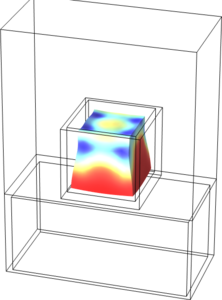
Microwave heating is widely used in thermal therapies, particularly microwave ablation (MWA), because it enables rapid and volumetric heating of biological tissue. However, elevated temperatures can induce water evaporation, thermal damage, and substantial tissue shrinkage, potentially altering the predicted temperature distribution and geometry of the treated region. Computational models capable of predicting microwave-induced tissue shrinkage remain limited, particularly those incorporating the combined effects of moisture loss and thermal damage on tissue deformation. This study experimentally and numerically investigates the thermal response and shrinkage behavior of ex vivo bovine liver exposed to different microwave input powers using a rectangular waveguide. The waveguide system provides a controlled experimental setup for regulating microwave power, sample position, exposure duration, and heating configuration. The experimental system consisted of a 2.45 GHz microwave generator, a power meter, a rectangular waveguide cavity, an acrylic sample container, and an approximately 4 cm × 4 cm × 4 cm bovine liver sample. A corresponding three-dimensional model was developed using COMSOL Multiphysics, incorporating the waveguide cavity, air, acrylic container, and liver domains, as illustrated in Fig. 1. The Electromagnetic Waves interface was used to calculate microwave propagation and power deposition within the liver, while the Heat Transfer in Solids interface was used to predict transient temperature evolution. Water-content loss was incorporated into the thermal model to account for evaporative heat loss, and thermal damage was evaluated using the Arrhenius equation. The Solid Mechanics interface was employed to predict tissue deformation. Two shrinkage-related strain components were considered: hygroscopic swelling strain associated with moisture loss and damage-induced strain associated with thermal damage. This coupled Multiphysics model enabled the prediction of transient tissue strain, dimensional changes, and volume reduction. Experiments and simulations were performed at different microwave input powers over a heating period of 10 min. Figure 2 presents the transient validation of the predicted temperature and liver volume reduction. The model reproduced the experimentally observed temperature increase and progressive tissue shrinkage under different input powers. The simulation results showed reasonable agreement with the experimental data for both temperature and volume reduction. Figure 3 compares the simulated deformed geometry with the experimental liver sample for Case 2 after 10 min, demonstrating that the model captured localized heating, inward deformation, and the overall reduction in sample size. Figure 4 compares the simulated and measured liver dimensions in the xz-plane, showing good agreement between the numerical and experimental results, with dimensional errors ranging from 2% to 7%. The proposed model efficiently predicts temperature evolution and tissue deformation. It may be further applied to electromagnetic-wave-based thermal therapies to predict tissue shrinkage and treatment-induced changes in tissue geometry.
下载
- 24 - Vannakorn Mongkol.pdf - 2.08MB
- 19311_final_poster.pdf - 0.52MB


