
Simulation aided design for capturing of superparamagnetic beads for medical diagnostics device
In this study we investigated and helped iterate on designs for a medical diagnostics device. It was early-stage product development with a strong focus on fast and agile iterations of initially conceptual designs and ideas, and later in the project more refined studies of the most promising designs.
Using COMSOL Multiphysics it was possible to quickly investigate different setups for how to arrange magnets and in which configurations, such that they most optimally retained superparamagnetic beads with a diameter 2.8 µm (Dynabeads M-280) commonly used in molecular diagnostics. Some application of such a system is capturing the beads from large volumes of liquid, where the beads could have been coated with reactants that can stick to bacteria or DNA that is desired to be concentrated. Larger beads can be used for circulating tumor cells, with the same design optimization applying for new bead size.
The model was a laminar CFD model with particle tracing for the beads. Stokes law was used for calculating the terminal velocity of the beads, when applying the magnetic force on the superparamagnetic beads in addition to gravitational sedimentation. The particle tracing used the stick condition, as that was close to what was seen when comparing to experiments, in that when a bead hit a wall it strongly stuck to it.
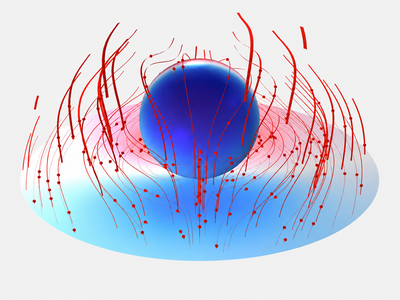
Many different iterations of the configurations were tested using the developed COMSOL Multiphysic Simulation model, and one of the learnings can be seen on the figures. A larger magnet results in higher magnetic fields, but what really traps the beads were high gradients in the magnetic fields, so many smaller magnets with opposing polarity gives a better capture, assuming that the flow can get sufficiently close to the magnets. The microfluidic channel design was therefore chosen for this specific iteration. Many different iterations were in play when designed for a more loosely defined problem definition, and COMSOL allowed for the rapid iterations and feedback loop that allowed for a wider solution space to be investigated.
下载
- 5 - Kresten Jensen.pdf - 1.45MB


