The Foundation: Scalable Architecture
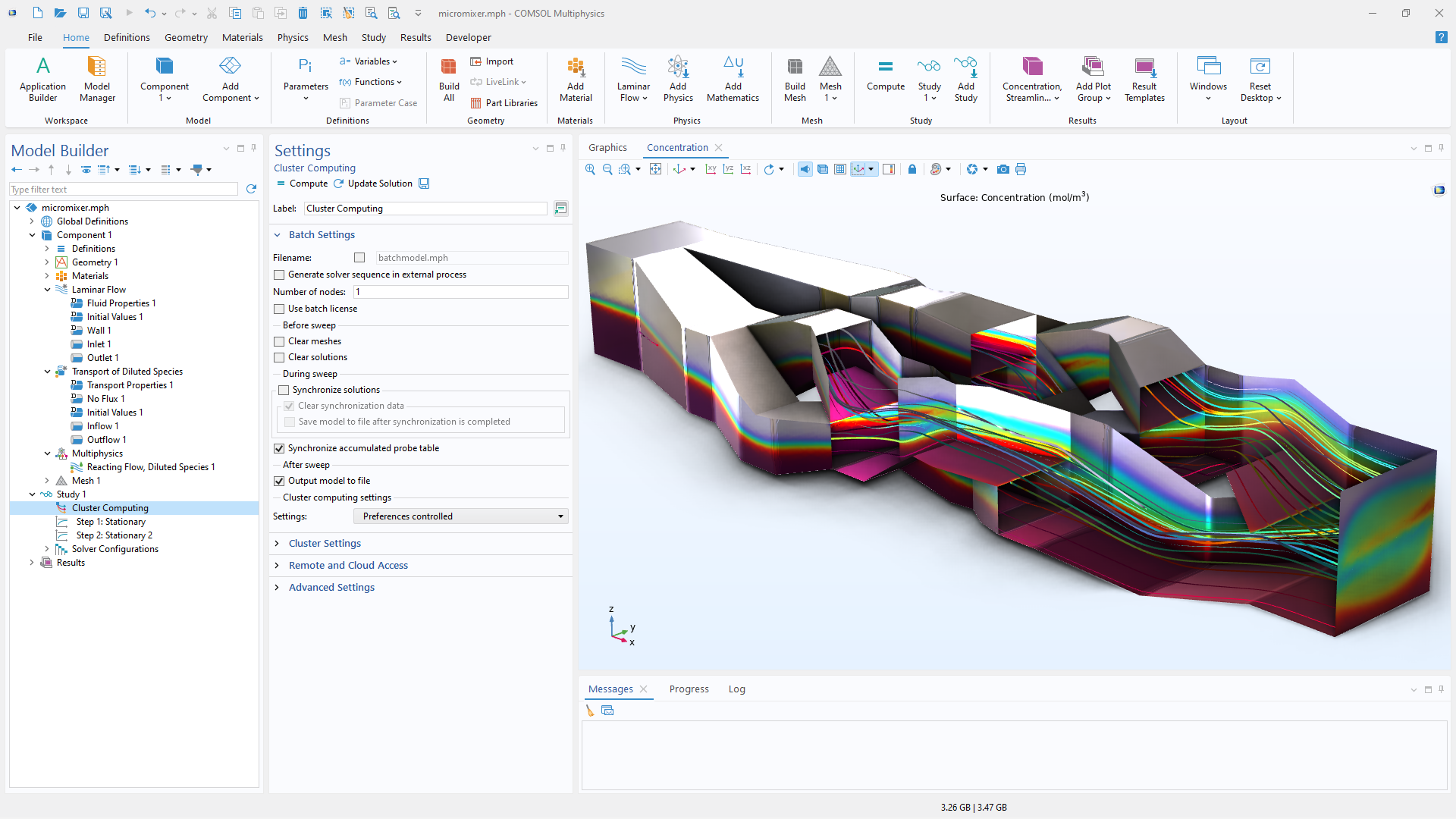
COMSOL Multiphysics® features a cluster-aware architecture that scales from local workstations to enterprise HPC environments and clouds. Following a one-time cluster configuration, the software automatically optimizes numerical workloads for a specific hardware. This ability enables engineers to transition from desktop prototyping to large-scale production runs without manual changes or repetitive cluster tuning.
Multicore or Multiprocessor Scaling (Shared-Memory Parallelism)
Take advantage of the full power of a workstation's hardware out of the box. COMSOL Multiphysics® uses shared-memory parallelism (via OpenMP®) to automatically distribute computational tasks over all available processor cores. This automatic parallelization means immediate performance gains for large high-fidelity models without the need for any software configuration. For shared-memory parallelism on a single computer, no additional license fees are required to run on an unlimited number of processor cores.
High-Performance Scaling (Distributed-Memory Parallelism)
Scale beyond the physical limits of a single machine by leveraging the pooled resources of a cluster. With a floating network license (FNL), no additional license fees are required to run on a cluster of unlimited size. By using MPI to partition a model’s memory footprint and computational load across multiple nodes, COMSOL Multiphysics® can perform high-fidelity simulations with hundreds of millions of degrees of freedom (DOFs). This capability enables users to run extensive mesh refinements or solve large, complex multiphysics models, as long as sufficient cluster hardware is available.
Maximizing Hardware Efficiency (Hybrid Memory Parallelism)
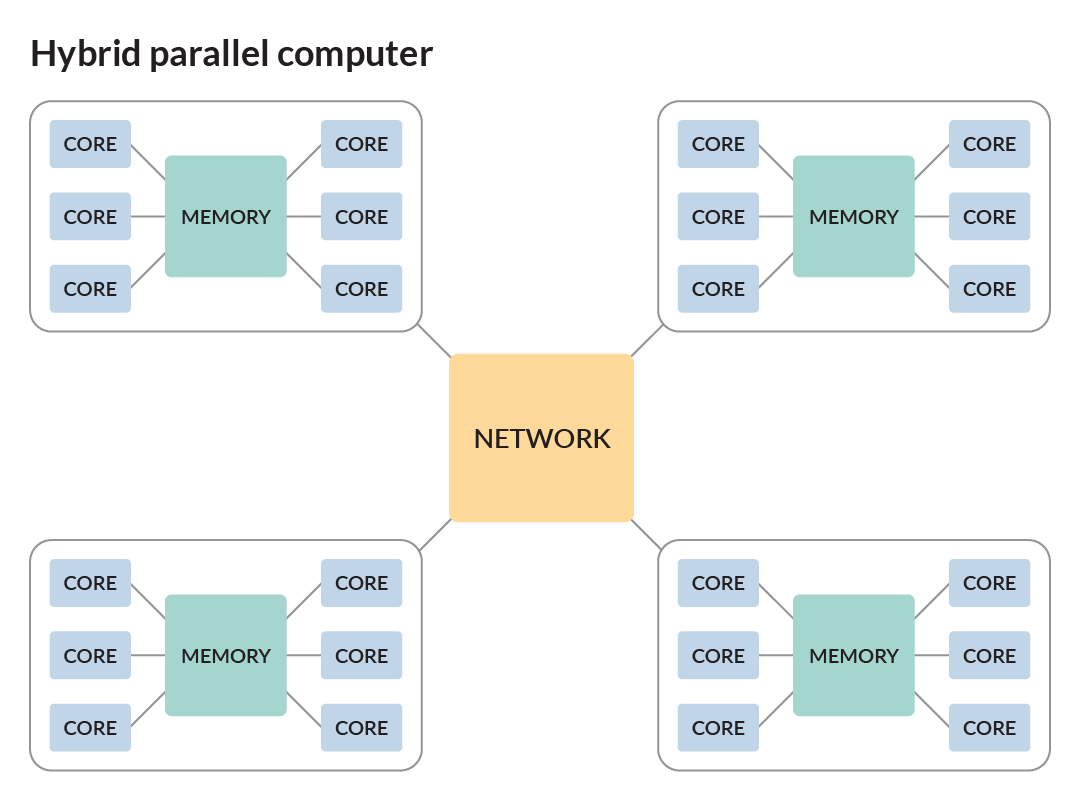
Maximize computational throughput by combining shared and distributed memory strategies. By balancing multithreading (via OpenMP®) within individual nodes and message passing (MPI) across a cluster, COMSOL Multiphysics® minimizes network communication overhead and optimizes hardware utilization. This hybrid approach ensures that simulations scale efficiently on modern many-core architectures, providing faster turnaround times and predictable performance across massive compute resources.